
💡 Key Takeaways
- Modern car keys require digital pairing with the vehicle’s immobiliser, not just a physical cut. The blade is often the cheapest part of the whole job.
- The Security Sync Gap is what happens when a physically correct key fails to start a car because its transponder chip has not been paired to that vehicle.
- A replacement key involves four distinct components: the metal blade, the transponder chip, the remote fob, and the vehicle’s immobiliser or ECU.
- Knowing your key type and having your VIN and proof of ownership ready before approaching anyone will save time and prevent unnecessary costs.
- Digital pairing almost always requires professional equipment, whether that is an independent auto locksmith or a franchised dealer.
- Arranging a spare key and keeping contact details for a trusted locksmith before anything goes wrong is worth doing now, not later.
Why Replacing a Car Key Isn’t Just About Cutting Metal Anymore
The common assumption is that a car key fails or works because of its shape. You collect a freshly cut key from a locksmith, walk back to the car, turn the ignition and expect the engine to respond. Instead, nothing happens. The blade fits the lock perfectly, but the car refuses to recognise it. That is not usually a bad cut. It is the Security Sync Gap, and it is the reason modern car key replacement feels so much more expensive than people expect.
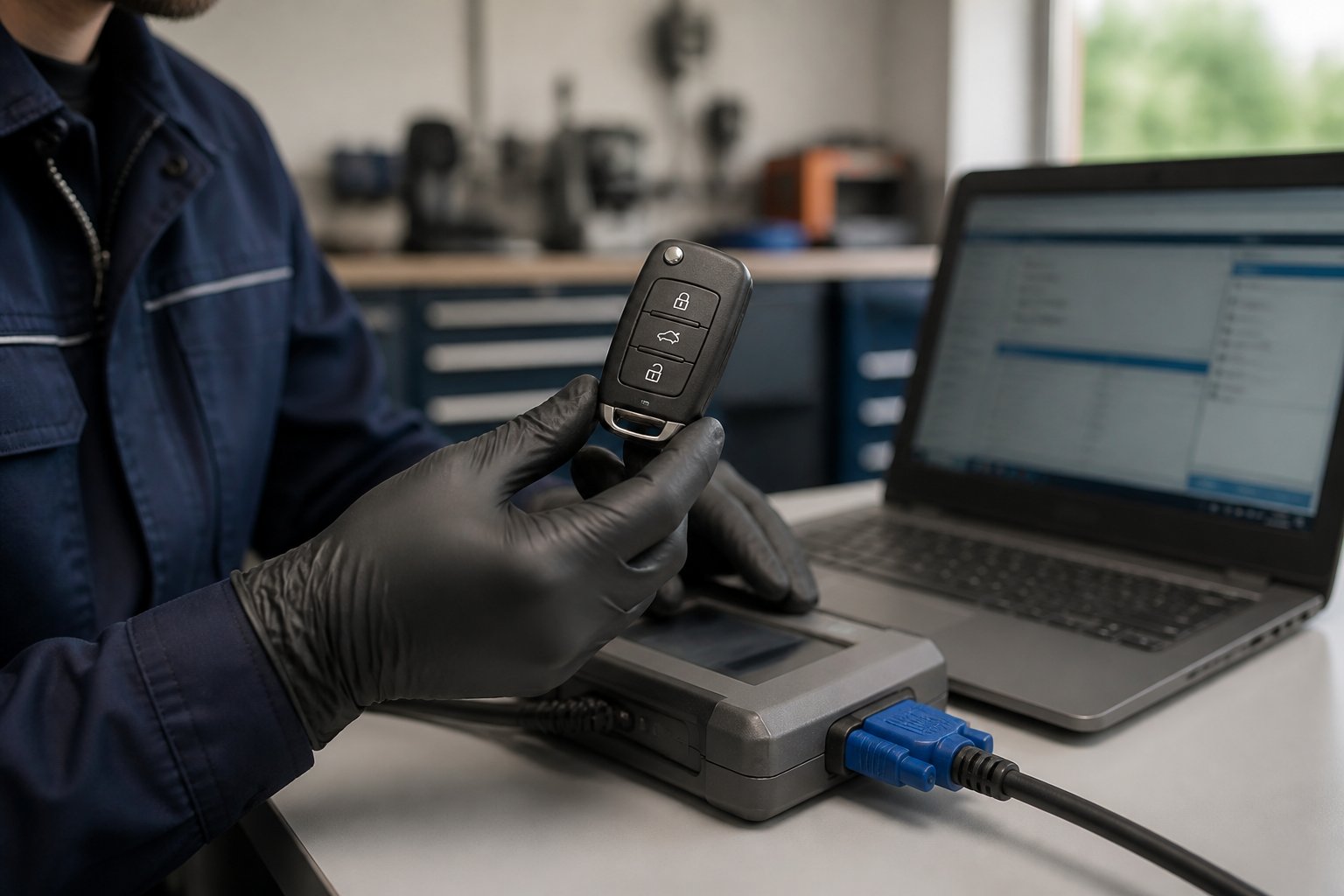
Most drivers still picture car key replacement as a version of copying a house key: hand it over, wait a few minutes, pay a modest fee and leave. That mental model is now out of date. Since manufacturers began embedding transponder chips into key heads, the key stopped being just a shaped piece of metal and became a digital credential. The car is not simply asking, “Does this blade fit?” It is asking, “Is this the authorised identity I have been taught to trust?”
On most vehicles built in the last decade, the physical cut is the straightforward part. The digital pairing is where the real work, the real risk and the real cost live. The important lesson is simple: with a modern vehicle, access and permission are not the same thing.
Modern car keys are security tokens. The metal blade opens the lock, but the transponder chip must be digitally paired with the car’s immobiliser. That programming step is the costly, critical part because it is what allows the vehicle to accept the key as legitimate.
- Blade = mechanical access to the lock
- Transponder = the key’s digital identity
- Programming = ECU pairing via OBD-II
From mechanical cuts to transponder programming: the Security Sync Gap
The Security Sync Gap is the moment a key that physically fits refuses to start the car. The immobiliser rejects the chip because it has not been paired to that specific vehicle. The blade handles entry; the chip handles identity. Those are two separate jobs, and most drivers only discover the distinction when they are stranded in a car park, holding a key that looks correct and behaves like a fake.
You can hold two visually identical keys and get completely different results at the ignition. In many systems, the chip is single-vehicle locked. That complexity is deliberate. It is designed to stop someone from simply copying the blade and driving away. The trade-off is obvious only when you need a replacement: the same system that protects the car from theft also makes legitimate replacement slower, more technical and more expensive.
Locksmiths regularly report that customers assume they are being overcharged when they see the bill. In many cases, the expensive part is not the blank key. It is the equipment, authorisation and knowledge required to persuade the vehicle’s immobiliser to trust a new digital identity. Professional-grade OBD-II programming tools, the kind used to communicate directly with a vehicle’s ECU, represent a significant investment on their own. Beyond the equipment, some platforms require the car to be physically present and connected via the OBD-II port for immobiliser pairing to complete.
This is why a mobile locksmith, who comes to wherever the car is, often makes practical and financial sense compared with arranging a tow to a dealership. The real value is not convenience alone. It is avoiding the chain reaction: recovery truck, dealer slot, part authorisation, then programming. In car key replacement, the hidden bottleneck is rarely the cut metal. It is the handshake between the chip and the car.
The four components you need to keep distinct
Most confusion, and most wasted money, comes from treating a car key as a single object. There are actually four distinct parts: the metal blade, the transponder chip embedded in the plastic head, the remote fob that handles locking and alarm signals, and the vehicle’s immobiliser or ECU that validates the chip during pairing. The blade is mechanical access. The chip is digital permission. The remote is convenience. The immobiliser is the gatekeeper.
Knowing which component is failing determines everything that follows, including who can fix it, what tools they need and what the job will cost. If the blade is worn, cutting may solve the problem. If the buttons have stopped working but the car still starts, the remote element may be at fault. If the car unlocks but will not start, the issue is more likely to sit with the transponder or immobiliser pairing. The mistake is assuming one symptom means one simple repair.
Professional tools map directly onto these four components. Physical key blanks and code cutters address the blade. OBD-II programming interfaces trigger ECU pairing modes, and the better units, such as the Autel IM608 or Advanced Diagnostics Smart Pro, cover a wide range of makes without requiring a dealer visit. Manufacturer-level security tools, the kind franchised dealers use, handle the most tightly encrypted systems. Whether those tools are accessible to an independent locksmith will largely determine your options and your final cost.
The practical takeaway is to describe the problem precisely before asking for a quote. “I need a new key” is too vague. “The blade turns, the doors unlock, but the immobiliser light stays on and the engine will not start” gives a technician something useful. Good diagnosis starts before anyone plugs in a machine.
Step 1, Identify your key type
Correctly identifying the key type before spending money saves the most time. Three categories cover the majority of vehicles on British roads: plain metal blades with no electronics, transponder keys with a plastic head housing a chip, and proximity smart keys with no exposed blade, which require smart key programming to pair correctly with the vehicle.
If you remove the plastic head and find a small glass or ceramic capsule, you have a transponder key. Buying the wrong blank leaves you with a key that fits the lock and does nothing else. It looks like progress, which is what makes it frustrating: you have solved the least difficult part of the job and left the important part untouched.
In the moment, especially during the stress of a lost key, it is surprisingly easy to skip this step. People search for the cheapest listing that matches the shape of their old fob, then discover that frequency, chip type and immobiliser compatibility matter more than the casing. The first thing to identify is not the design of the shell. It is what the car expects to hear from the chip.
Step 2, Retrieve your VIN and proof of ownership
In the UK, any reputable locksmith or dealership will require the vehicle identification number (VIN) and photographic ID before proceeding. This is a legal safeguard, not bureaucracy. A technician who is willing to programme a key without checking ownership is not being helpful, they are removing one of the protections that makes the immobiliser system worth having.
The VIN is printed on a plate in the door frame, stamped on the chassis, and recorded in the vehicle handbook and service invoices. Locate it before you need a replacement, not during the emergency. If the car is locked and the paperwork is in the glovebox, a simple replacement task can become unnecessarily awkward.
Having documents ready not only speeds things up but often reduces the final bill. Without them, expect delays while identity is confirmed, and expect that time to appear on the invoice. Bring your VIN and photo ID, and ask in advance whether the locksmith needs the car present. The better question is not just “Can you cut this key?” It is “What do you need from me so the car will accept it?”
Step 3, Source the correct hardware
OEM parts offer guaranteed compatibility and typically arrive pre-authorised for dealer programming. Aftermarket shells and PCB kits cost less, but need careful selection. Many marketplace listings labelled “unlocked” falsely imply the chip is unpaired and ready to programme to any vehicle. In many systems the chip is single-vehicle locked, and one-time programmable chips cannot be reused once paired elsewhere.
If you are sourcing a remote fob, confirm that programming is included in the quoted price. Some suppliers charge separately for the pairing step. A cheaper online fob looks like a saving until programming fails, at which point you have paid twice: once for the part, and once for someone to sort out the mess. The lowest price is often attached to the highest uncertainty.
Budget-conscious owners often get better value from a mobile locksmith who sources compatible parts and handles programming as a single job. A mobile technician arrives at the vehicle with the right OBD-II tooling already loaded, cutting out dealer waiting times and reducing the risk of a mismatched part. The trade-off is that you may not always receive an OEM-branded key, so owners who care about exact factory appearance or long-term dealer support may still prefer the franchised route.
Step 4: Execute the digital pairing (transponder/OBD-II programming)
There are two routes. A mobile locksmith with professional OBD-II tools performs on-site transponder programming and carries equipment matched to your specific vehicle. The DIY route, using an aftermarket programmer, can save on labour costs, but carries a real risk of triggering immobiliser lockouts or corrupting the ECU if the protocol is not followed precisely for your make and model. DIY makes most sense on older, well-documented vehicles where the process is known and the owner is comfortable following technical steps without improvising.
This is where many DIY attempts go wrong. The programmer connects, the software appears to be running correctly, then the ECU rejects the sequence because battery voltage dipped slightly mid-write. The vehicle will not start. The original key may also begin behaving oddly, which compounds the problem considerably. What feels like a small electrical interruption can become a security failure because the car cannot distinguish between a bad programming attempt and a suspicious one.
Connect a fully charged backup power supply before starting any OBD-II pairing sequence. Do not rely on the car’s battery alone, particularly on older vehicles. Battery condition is one of the least glamorous parts of key programming, but it can be the difference between a clean write and an immobilised car.
A typical professional visit involves the technician connecting a diagnostic tool and triggering the ECU’s learning mode. That process usually takes 10–20 minutes, though it varies by make and model. Ask to see a “key write successful” confirmation before signing off. Without it, you have no recourse if the key fails the following morning. The moment that matters is not when the blade turns, it is when the vehicle confirms that the new identity has been accepted.
Common mistakes that cost time and money
- Fobs listed as “unlocked” are often already paired to another vehicle. The blade looks correct but the transponder chip is wrong.
- A weak battery can interrupt the pairing sequence mid-write and trigger immobiliser issues that are harder to resolve than the original problem.
- A freshly cut blade will not start the engine without a paired transponder chip. The immobiliser validates the chip before allowing ignition, regardless of how well the blade is cut.
The most expensive mistake is usually not buying the wrong key, it is continuing after the first warning sign. A common pattern is familiar: an owner finds an online tutorial, buys a programmer that appears compatible, starts the sequence, then discovers halfway through that their model requires manufacturer-level access at a specific stage. The software stalls. Neither key behaves as expected. At that point, the job has shifted from replacement to recovery.
Vehicles that use rolling security protocols are particularly unforgiving. The pairing window is short. Miss it and you are starting over, sometimes from a significantly harder position than before. This is where theory meets reality: a key can be cheap, the fix for a failed programming attempt rarely is.
Prepare now, before you lose a key
Keep a spare key. Store the key code and VIN somewhere secure. Save contact details for two trusted independent locksmiths, one mobile and one with a fixed premises. Most people search for all of this under stress, which is precisely when decisions get rushed and costs rise.
For many vehicles, particularly those around ten years old or more, a spare key cut and paired in advance costs a fraction of what an out-of-hours replacement will run you. The spare key is not just a backup object in a drawer. It preserves choice. With one working key available, programming is often simpler, ownership checks are easier, and you are not negotiating from the side of a road or a supermarket car park. One phone call made today can prevent a very expensive one later.
When to choose a professional, and what it will cost
The right route depends on your vehicle’s age, key type, and how much risk you are willing to carry. The cheapest route is not automatically the best route, and the dealer route is not automatically excessive. The decision turns on complexity, urgency and tolerance for inconvenience. These triggers should help guide the decision:
- If your vehicle is over ten years old and uses a simple transponder an independent locksmith or a careful DIY approach can save real money. OBD-II pairing tools are widely available for common platforms, and for a single older vehicle they can be a reasonable option if you are confident with the process.
- If your vehicle is recent or uses an encrypted smart key dealer-level tools and manufacturer security credentials are often the only route that actually works. In many cases, they are not optional.
- If you need speed or out-of-hours support a mobile locksmith is usually faster than a dealer booking. Call-out rates reflect that convenience, but the time saving is often worth it when the car cannot be moved.
- If guaranteed OEM compatibility matters more than cost choose the franchised dealer route. Lead times on part authorisation can be longer, but compatibility is generally assured.
Before calling a dealer, check your motor insurance policy, breakdown cover, or any remaining warranty. Some policies include a key-replacement benefit or a contribution toward dealer costs. This is one of the easiest savings to miss because drivers usually check cover after they have already paid. Confirming this first can meaningfully reduce the bill.
Always ask for a written quote before committing. Prices vary considerably by make, model, and region. You can review ownership and VIN documentation requirements via GOV.UK vehicle registration guidance.
These are typical UK ranges gathered from industry practitioner interviews and dealer price checks (2024–2025). Actual quotes will vary by make, model, and region:
- Independent locksmith with aftermarket fob and OBD-II pairing: typically £80–£160 for most common transponder and remote key systems. Usually the most cost-effective route for vehicles up to around ten years old, though it varies by make and model.
- Franchised dealer with OEM key and manufacturer-level programming: typically £250–£450, sometimes higher for prestige or late-model vehicles with advanced encryption. Compatibility is generally guaranteed, but expect longer lead times on part authorisation.
- DIY programmer hardware for a specific make or platform: typically £40–£120 for the device. Only worth considering if you are programming multiple keys on the same platform. For a one-off job, a mobile locksmith will often cost roughly the same, with none of the setup risk.
You can find a vetted UK locksmith through the Master Locksmiths Association (MLA).
Whichever route you choose, the core cost is never really about cutting the metal. You are paying for the digital pairing, the authorisation, and the expertise to make all three layers work together: the physical key, the transponder, and the car’s immobiliser system. If your car is older and simple, an independent locksmith is often the sensible middle ground. If your car is newer, encrypted or still under warranty, the dealer may be the safer choice. If you are considering DIY, be honest about the risk: one successful write saves money, one failed write can erase the saving immediately.
Last reviewed: 2 April 2025. Vehicle security protocols evolve; if your vehicle was registered after 2022, confirm current pairing requirements with a qualified technician before sourcing parts.
Frequently Asked Questions
Why is car key replacement more than cutting metal?
Modern keys contain a transponder chip that must be digitally paired with the car’s immobiliser. Cutting the blade gets you through the door, but without the correct encrypted signature the engine simply will not start. The blade proves shape, the chip proves permission.
What is the “Security Sync Gap”?
It describes what happens when a physically correct blade fails to start a car because the immobiliser does not recognise the chip’s encrypted signature. The blade fits. The digital handshake does not.
Can I programme a transponder key myself?
Some older vehicles allow basic self-programming using an existing key. Most modern cars, though, require specialist OBD-II equipment and manufacturer-level access. Attempting it without the right tools can lock the immobiliser entirely, turning a straightforward job into a considerably more expensive one.
Why do dealerships often charge more for key replacements?
Dealers use manufacturer-level security tools to programme tightly encrypted systems and supply OEM parts with guaranteed compatibility. The higher price reflects specialist access, authorised parts and lower compatibility risk, not a simple markup on cut metal.
Will insurance or breakdown cover pay for key replacement?
Some motor insurance and breakdown policies include a contribution toward replacement costs that many drivers overlook entirely. Check your policy documents before calling a dealer, as cover limits and excesses vary significantly between providers.
How much does a replacement car key typically cost in the UK?
An independent locksmith typically charges £80–£160 for common transponder and remote keys. A franchised dealer tends to charge £250–£450, or more for advanced proximity systems. Figures vary by make, region and complexity, so a written quote matters.
What should I do to prepare for a lost car key?
Keep your VIN, photo ID, and proof of ownership accessible, and confirm in advance whether the locksmith needs the vehicle present. Getting a spare cut and paired before you ever lose a key is almost always the cheapest and least stressful option.